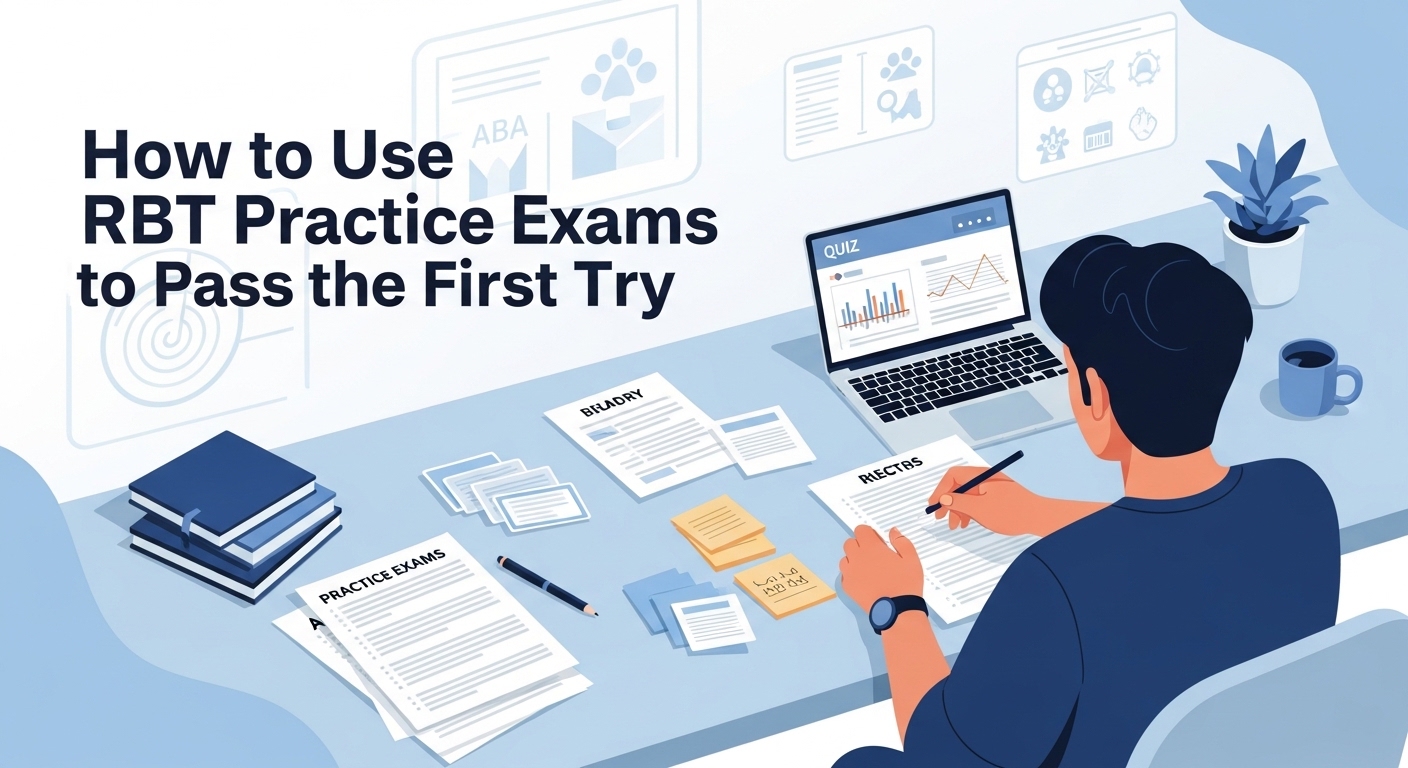
Every year, thousands of aspiring Registered Behavior Technicians sit down to take the BACB certification exam — and a surprising number walk away disappointed. Not because they lacked the passion for the work, and not because they didn’t study at all. They failed because they studied the wrong way.
Rereading notes, passively watching videos, and highlighting textbooks can create the illusion of preparation. But when exam day arrives and the clock is running, that passive knowledge often crumbles under pressure. The candidates who pass on their first try almost always share one habit: they used RBT practice exams strategically, early, and often.
In this guide, you’ll learn exactly how to use RBT practice exams to pass the RBT test on your first try — from taking your very first diagnostic mock test to recognizing when you’re genuinely ready to schedule the real thing. Whether you’re just starting your RBT exam prep or you’ve been at it for weeks, this step-by-step plan will sharpen your strategy and boost your confidence.
Here’s what we’ll cover:
Before you can prepare well, you need to know exactly what you’re walking into. The RBT certification test is developed and administered by the Behavior Analyst Certification Board (BACB) — the governing body for the field of applied behavior analysis (ABA).
The exam is designed to verify that candidates have the foundational skills to work as paraprofessionals under the supervision of a Board Certified Behavior Analyst (BCBA). Earning this credential signals to employers, families, and the broader ABA community that you meet a professional standard.
| Feature | Details |
|---|---|
| Total Questions | 85 (75 scored + 10 unscored pilot items) |
| Time Limit | 90 minutes |
| Passing Score | Approximately 68% (scaled score of 200 out of 250) |
| Format | Computer-based, multiple choice |
| Administered By | Pearson VUE testing centers |
| Eligibility | Must complete 40-hour training, pass competency assessment, and pass background check |
The BACB RBT exam pulls questions from six task list areas. Understanding these domains is critical for targeted study:
Knowing how many questions come from each domain helps you prioritize your RBT study guide and RBT mock test sessions.
There’s a concept in cognitive psychology called the testing effect — and the science behind it is robust. Retrieving information from memory during a test strengthens that memory far more than re-reading the same material ever could.
In other words, struggling to recall an answer is more valuable to your brain than recognizing the answer when you see it highlighted on a page.
Here’s why RBT practice exams are so much more effective than passive review:
They expose real knowledge gaps. You might feel like you understand discrete trial training — until a scenario-based RBT exam question exposes that you’re confusing it with naturalistic teaching. Practice tests are brutally honest in a way your notes never are.
They build familiarity with question formats. BACB exam questions are deliberately worded to test application and judgment, not just recall. The more BACB-style RBT exam questions you encounter, the more comfortable and efficient you’ll become at interpreting what’s actually being asked.
They reduce test anxiety. Exam anxiety often comes from fear of the unknown. By simulating real testing conditions over and over, you normalize the experience — your nervous system stops treating it like a threat.
They improve time management. 90 minutes for 85 questions means roughly 63 seconds per question. Students who never practice under timed conditions frequently run out of time on the actual Registered Behavior Technician test. Practice builds the pacing instinct you need.
They improve long-term retention. Spaced repetition combined with active recall — the core mechanics of good practice testing — is one of the most evidence-backed learning strategies in educational psychology.
Simply put, an RBT mock test does what passive studying cannot: it forces you to perform, not just consume.
This isn’t about grinding through as many RBT practice exam questions as possible. It’s about using each practice session deliberately. Follow these four steps in order.
Before you do anything else, sit down and take a full-length RBT practice exam under realistic conditions. Don’t review your notes first. Don’t look anything up. Just attempt it cold.
This baseline assessment will feel uncomfortable — and that’s entirely the point. It shows you where you actually stand, not where you think you stand.
What to do:
Your baseline score tells you which content areas are already strong and which ones are dragging you down. This is the foundation for everything that follows.
After your baseline mock test, resist the urge to simply check how many you got right overall. That number alone doesn’t help you study smarter.
Instead, break down your score by domain. Which of the six RBT task list areas did you struggle with most? Were your Behavior Reduction questions consistently wrong? Did you do well on Measurement but stumble on Professional Conduct questions?
Create a simple tracking sheet:
| Domain | Baseline % | Week 2 % | Week 3 % | Target % |
|---|---|---|---|---|
| Measurement | 80%+ | |||
| Skill Acquisition | 80%+ | |||
| Behavior Reduction | 80%+ | |||
| Documentation | 80%+ | |||
| Professional Conduct | 80%+ | |||
| Responsiveness to Supervision | 80%+ |
Tracking your scores over time reveals trends. When a domain stops improving despite continued study, it often signals that you need a different learning approach for that content area — not just more repetition.
Once you know your weak domains, dedicate focused study blocks to those areas using your RBT study guide, the BACB RBT Task List, and scenario-based practice questions.
This is where many students go wrong: they review their wrong answers by reading the correct answer and moving on. Don’t do this.
For every incorrect answer, ask:
This active approach converts a wrong answer into a learning event. It also makes the concept far more likely to stick when a similar RBT exam question appears on the actual test.
After two to three weeks of targeted review, return to full-length timed mock exams. Your goal now is two-fold: validate that your weak areas have improved, and build the stamina and pacing needed for the real BACB RBT exam.
Retake guidelines:
Each completed mock exam reinforces time management, reduces anxiety, and sharpens your instinct for ABA terminology in context.
Practice exams work best when combined with the right supporting strategies. Here are the most effective techniques for RBT exam prep:
Active Recall Over Passive Review. Instead of rereading your notes, close them and try to write down everything you remember about a topic from scratch. This is more mentally demanding — and dramatically more effective.
Spaced Repetition. Rather than cramming a topic once, review it at increasing intervals: one day later, then three days later, then one week later. Apps like Anki are great for this with ABA flashcards.
Time-Blocked Study Sessions. Study in focused 45-to-60-minute blocks with short breaks in between. Research consistently shows this outperforms marathon study sessions for retention and focus.
Study Groups. Explaining ABA concepts to a peer in plain language is one of the fastest ways to identify gaps in your own understanding. If you can teach it, you know it.
Master ABA Terminology. Many RBT exam questions hinge on precise terminology. Confusing “positive reinforcement” with “negative reinforcement,” for example, can cost you several questions. Build a working vocabulary and use the terms actively.
Focus on Scenario-Based Questions. The RBT exam is application-heavy. You’ll be presented with client scenarios and asked what the appropriate action is. Practice these specifically — they require judgment, not just memorization.
Even hardworking, motivated candidates make avoidable errors during their RBT exam prep. Here are the ones that show up most often:
Memorizing answers instead of understanding concepts. If you’ve done a practice test twice and started to remember specific answer choices, you’re not learning — you’re memorizing. Rotate between multiple question banks and RBT mock test sources to keep things fresh.
Ignoring weak domains. It’s tempting to keep practicing in areas where you’re already strong because it feels good to get things right. But the exam doesn’t reward you for excellence in one area and punish weakness in another; every question counts equally. Target your lowest scores relentlessly.
Taking practice tests without reviewing them. A practice test you don’t analyze is essentially wasted time. The review phase — especially understanding why you got something wrong — is where real learning happens.
Cramming the night before. Sleep is a core part of memory consolidation. Studying until 2 AM the night before your RBT certification test will hurt your performance more than help it. Spend that evening reviewing key concepts lightly, then rest.
Using outdated study materials. The BACB updates its RBT Task List periodically. Make sure your RBT study guide and practice exam questions reflect the current task list version. Using materials from several years ago may mean studying content that’s no longer tested — or missing content that is.
This four-week plan assumes you’re starting from scratch with your RBT exam prep. Adjust based on your baseline score results.
| Day | Study Focus | Practice Activities |
|---|---|---|
| Week 1, Day 1 | Baseline assessment | Full timed mock exam (85 questions) |
| Week 1, Days 2–3 | Measurement & Skill Acquisition | Flashcards, targeted practice questions, task list review |
| Week 1, Days 4–5 | Behavior Reduction & Documentation | Scenario-based questions, study guide reading |
| Week 1, Day 6 | Professional Conduct & Supervision | ABA ethics review, terminology drills |
| Week 1, Day 7 | Rest & light review | Review key terms; no full exam |
| Week 2, Days 1–3 | Weak domain deep dive | Focused practice sets on lowest-scoring domains |
| Week 2, Days 4–5 | Mixed domain review | Untimed 30-question mixed sets |
| Week 2, Day 6 | Second full mock exam | Timed, realistic conditions |
| Week 2, Day 7 | Review mock exam results | Domain score analysis, wrong answer review |
| Week 3, Days 1–4 | Targeted remediation | Active recall, peer teaching, flashcards |
| Week 3, Days 5–6 | Third full mock exam + review | Timed exam, full analysis session |
| Week 3, Day 7 | Rest | Light review of ABA core concepts only |
| Week 4, Days 1–3 | Final weak area focus | Practice questions, scenario-based review |
| Week 4, Day 4 | Fourth full mock exam | Timed, simulated exam conditions |
| Week 4, Day 5 | Review & final prep | Light review, confidence-building |
| Week 4, Day 6 | Rest and prepare | Gather materials, plan travel to testing center |
| Week 4, Day 7 | Exam day | RBT Certification Test |
One of the trickiest parts of exam prep is knowing when you’re genuinely ready versus when you’re just hoping you are. Here are the clearest indicators that it’s time to schedule your RBT certification test:
You’re consistently scoring 75–80% or higher on practice exams. Aim for this range across at least three consecutive full mock tests. A one-time high score could be a lucky day; consistency is confidence.
You’re finishing within the time limit. If you’re regularly completing all 85 questions with 10 or more minutes to spare, your pacing is where it needs to be.
You can explain concepts in your own words. Pick any topic from the RBT task list and explain it aloud without looking at notes. If you can do it clearly and correctly, you know the material deeply enough.
Your weak domains are no longer weak. Check your domain tracking sheet. If the areas that were dragging you down in week one are now at 75%+, you’ve done the work.
You’re reading questions rather than reacting to them. Confident test-takers slow down, read carefully, and eliminate wrong options methodically. If that’s how you feel during practice, you’re ready.
Getting started is the hardest part. Here’s how to begin your RBT mock test practice today, using free and low-cost resources:
The best RBT practice exam is the one you actually start. Don’t wait until you feel “ready enough” — that feeling comes from doing the work, not from waiting.
Most successful candidates complete between four and six full-length mock exams before sitting for the real test. The key isn’t the number — it’s consistent improvement across domains and completing each one under timed, realistic conditions. If you’re scoring 75%+ consistently by your fourth or fifth exam, you’re likely ready.
It depends on the source. High-quality practice exams are designed to be at or slightly above the difficulty of the actual BACB RBT exam, so that the real test feels manageable by comparison. Avoid sources that are significantly easier — they’ll give you false confidence. If you’re consistently scoring above 80% on a particular mock test with very little effort, find a more challenging question bank.
Aim for a consistent 75–80% across multiple timed mock exams before scheduling the real RBT certification test. The actual passing score is roughly 68%, so aiming higher in practice gives you a comfortable buffer for the added pressure of the real exam environment.
Technically possible, but highly inadvisable. The RBT exam heavily tests application and judgment — not just recall. Without practice with scenario-based questions and timed conditions, most candidates significantly underestimate the exam’s demands. Practice tests are the closest simulation of the real test experience available to you.
Most candidates spend three to six weeks studying, averaging one to two hours per day. Candidates with less ABA work experience may benefit from closer to six to eight weeks. The quality of your study time matters more than the quantity — focused, active study sessions outperform long, unfocused ones.
Most test-takers report the greatest difficulty with scenario-based questions across Skill Acquisition and Behavior Reduction, where the right answer requires applying multiple ABA principles simultaneously. Measurement questions — particularly around data collection and graphing — also trip up candidates who haven’t practiced interpreting behavior data in context.
Free RBT practice exams vary widely in quality. The best free resources are those developed by BCBAs or organizations with deep knowledge of the BACB task list. Check whether the questions are scenario-based and aligned with the current RBT Task List 2nd Edition. If a free exam is entirely recall-based (defining terms rather than applying them), treat it as supplemental rather than primary practice.
Failing the RBT exam is discouraging, but it’s not the end. The BACB allows candidates to retake the exam, though there are waiting periods and attempt limits. Use your score report to identify which domains need the most work, adjust your study plan, and approach your retake more strategically. Many RBTs pass on their second attempt after targeted remediation.
Passing the RBT exam on your first try is absolutely achievable — but it requires more than good intentions and a stack of notes. The candidates who walk out of that testing center with a passing score are the ones who treated their RBT exam prep as active, deliberate practice rather than passive review.
Start with a diagnostic mock test to ground your prep in honest data. Analyze your domain scores, target your weakest areas, and return to full-length timed exams to build the speed and confidence you need. Avoid the common traps — passive studying, ignored weak spots, last-minute cramming — and stick to a consistent weekly plan.
The RBT certification test is your gateway into a deeply meaningful career helping individuals with autism and other developmental disabilities reach their full potential. That work is worth the effort it takes to prepare well.
You have everything you need to pass. Now go start your first practice exam — today, not tomorrow. The first score won’t be perfect, and that’s exactly the point. Use it to learn, improve, and build the confidence that carries you through on exam day.
This article is for educational purposes and reflects general best practices for RBT exam preparation. Always refer to the official BACB website (bacb.com) for the most current exam requirements, task list updates, and eligibility information.